


Braiding machines are specialized devices that weave yarns, fibers, or wires into durable, flexible structures used across various applications, including textiles, automotive, medical, ropes, and aerospace industries. At the core of these machines, several key components—such as carriers, track plates, take-off and take-up systems, and control panels—work in coordination, each contributing to the machine’s efficiency, flexibility, and product quality.
Understanding Braiding Machine Components and Functions
In the following article, we’ll look at the main parts that make up a braiding machine, showing examples and explaining their main function and description.

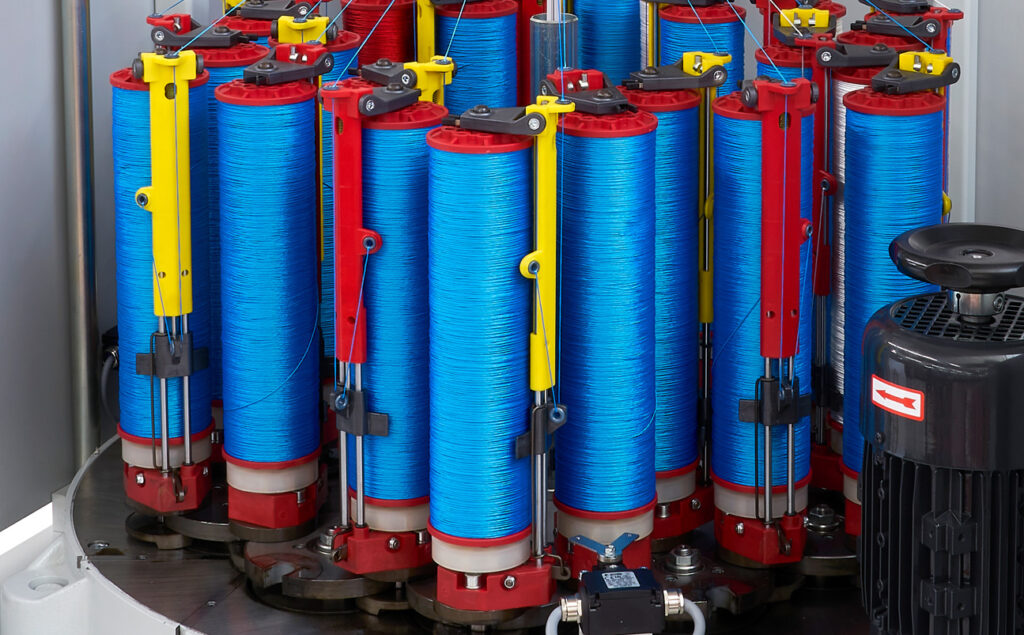
1. Carriers
- Function: Holds and guides the bobbins of yarn, wire, or fiber as they feed into the braiding process.
- Description: Carriers, also called spindles, move along specific paths to interweave the materials. The size of the carriers depends on the horn gear gauge. The carrier is a critical component of the braiding machine, ensuring a constant feed of material, which is key to producing uniform braids. The setup of the carriers determines whether they are suitable for thicker or thinner threads, as well as fibers with higher or lower tenacity. Ratera offers a wide range of carriers for all kinds of fibers, wires and yarns. The tension of the carrier is adjustable through tension springs and other methods tensioning methods.

2. Bobbins
- Function: These hold the material (fiber, wire, or thread) and release it in a controlled manner as it is braided.
- Description: The bobbin size will determine the length without splices of the braid produced and also the timing between bobbin doffing cycles. This is directly related to the manpower costs associated to the product. Thanks to the robustness & precision machining of Ratera braiders, Ratera offers the best relation of bobbin capacity & production speed in the market, ensuring quality of the braid.
Bobbins are prepared using a winding machine, which ensures proper winding. A high-quality winding process is essential for achieving a good-quality braid. Click here to see some of Ratera winding solutions: Winding Machines – Ratera
3. Track Plate (Braider Head)
- Function: Directs the motion of the carriers.
- Description: The track plate defines the braiding pattern, such as regular round, solid cord, or flat braid. It consists on a high precision machined steel plate with 1 or 2 tracks for which the carriers will move. It is located above the oil bath, which houses the gears that drive the machine. The horn gear slots guide the movement of the bobbin carriers through the tracks. The horn gear diameter, measured in millimeters, determines the braiding machine Gauge. The larger the horngear gauge, the larger the carrier & bobbin can be — allowing for the production of longer braids and the processing of thicker yarns.
Click here to see all Ratera Braiders classified by Gauge: Braiding Machines – Ratera


4. Braiding Point
- Function: The convergence points where individual threads or wires interweave to form a braid.
- Description: The braided material tends to form naturally at a specific braiding point. It depends on the speed relation between the take-off system and the trackplate, determining the braiding angle and therefore, the picks per cm/inch (PPcm or PPI) and the helix pitch. However, certain mechanisms, such as mandrels, rings, or braid point dies, can influence this point to create specific effects on the braid. Additionally, sensors can detect issues such as a braiding point fall or a carrier getting tangled.
5. Take-Off System
- Function: Pulls the finished braid away from the braiding point, maintaining consistent tension and speed.
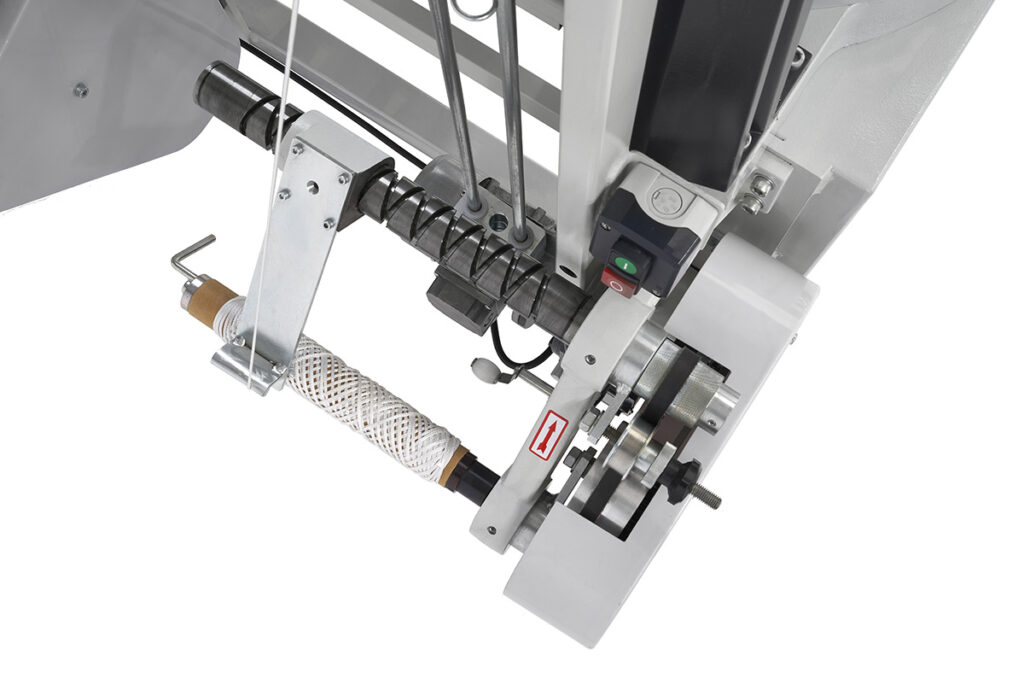
- Description: The take-off system, also called capstan, extracts the braided material consistently. Depending on the type of product made, several capstan shapes and mechanism are available: big wheels combined with take-up units, multiple wheels with grooves, stainless steel calandar for medical or even haul-off units for tubing or Robots for 3D braiding. The speed relation between the trackplate and the capstan will determine the Picks per cm or helix pitch of the resulting braid. It can be mechanically driven and the speed is adjusted with take-off gears. Alternatively, it may be powered by a gearmotor, allowing for electronic control of the helix pitch or the number of stitches per centimeter through a digital interface.

6. Take-Up Unit (Product Collection)
- Function: Collects the finished braided material in an organized manner.
- Description: The take-up system, also called a collector, gathers the finished braid in an organized manner, usually onto a spool or reel. In some cases, the braid may be left to fall freely into a can (free-fall collection), or it may require an orderly collection. For example, fine braids such as fishing line or suture, will require a take-up unit to prevent tangling. Smaller take-up units are typically mounted on top of the machine, providing space saving and comfortable operation. For medium size spools, they are typically mounted at the back of the braider, close to the floor for better manipulation. For larger products, such as pipes or large rope hanks, the take-up system may be an additional machine working in coordination with the braider. Depending on the next process, the braid can be wound in parallel or cross-wound onto a cardboard core, according to the desired collection method.
Check this link for more information about Ratera Take-Up units: Take-up Units and Collectors for Ropes, Hoses and Cable – Ratera
7. Pay-Off System (Core Feeding)
- Function: Feeds the core material into the braiding machine.
- Description: A braid may have a core or not. For example, a climbing rope would typically have several cores and the braid provides an outer jacket. A mooring rope of 8 strands, usually will not have any core. So, this system doesn’t always need to be part of the braider itself. If a core is required, the machine usually operates with an external creel that holds the spools of core material. At the braiding machine, specific devices such as elastic stretching systems, pullies, or tensioners, ensure that the core is fed correctly. Some machines also include core presence sensors.


8. Protections
- Function: Ensures operator safety and protects the machine from damage.
- Description: Braiding machines should comply with the ISO 11111 standard for textile machinery safety. This standard dictates different levels of protection depending on the size of the machine. Larger machines often require more substantial safety guards, while smaller machines need fewer protections. These safeguards typically surround moving parts, including emergency stop mechanisms and other safety controls. Ratera offers the possibility to customized protection according to country or customer specific requirements, such as full enclosures or enhanced elements for noise reduction.
9. Drive Mechanism
- Function: Powers the rotation and movement of carriers and the take-off system.
- Description: The motor controls the speed of the machine, synchronizing the movement of the carriers, take-off system, and other mechanical components. Adjustments to the speed and tension of the braiding process can be made depending on the machine’s setup. Ratera has also pioneered the use of servomotors for driving & powering the braiders for various reasons, such as medical compliance and enhanced pattern control functionalities. As an example, the new and patented model 17B-E120 for round-flat-round braids. More information here: EN_Sutures.pdf


10. Control Panel
- Function: Allows the operator to adjust machine settings.
- Description: Depending on the machine’s complexity and customer requirements, the control panel may range from a basic start-stop setup for simpler machines to sophisticated touchscreen interfaces. Advanced control panels allow operators to adjust parameters such as braiding speed, stitch rate, and production parameters electronically. In between, Ratera offers a wide range of possibilities, such as meter-counters, reverse buttons, potentiometers for simple speed control. Finally, Ratera is capable of offering real-time monitoring solutions for your braiding plant. (Industry 4.0. – IoT) or custom make electrical applications.
11. Sensors
- Function: Monitors critical aspects like thread breakage or meters produced.
- Description: Sensors play a critical role in the efficient and safe operation of braiding machines. Key examples include:
- Anti-tangling switches: These halt the machine if a knot forms in the braid, preventing damage and maintaining product quality.
- End-stops: These sensors detect when a bobbin runs out of material or if a thread breaks, enabling timely intervention to minimize downtime.
- Core presence sensors: These ensure that the core material is correctly positioned during braiding.
- Safety sensors: These monitor operational safety, such as verifying that doors are securely closed before operation.
- Production output sensors: Devices like meter counters track the length of the braid produced, aiding in quality control and production management.
A wide variety of additional sensors may be incorporated depending on the braider model and the specific requirements of the product being manufactured.

In summary, a well-configured braiding machine can reliably produce high-quality braids, making it invaluable for both aesthetic and functional braided products. For support specifying a braiding machine, please, contact Ratera here.